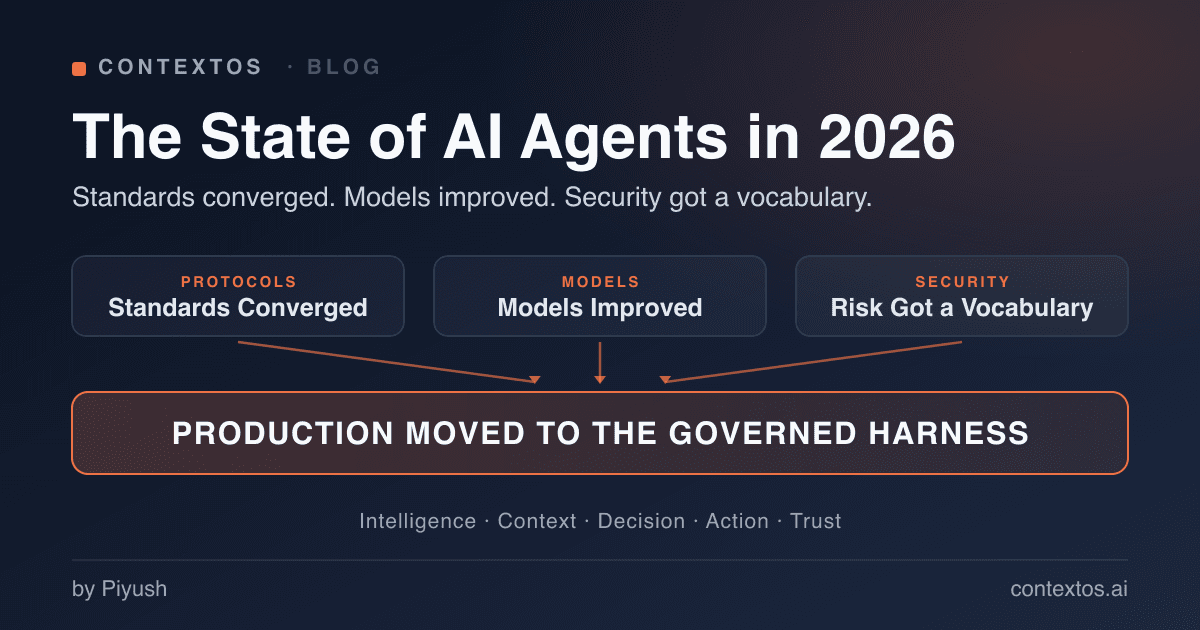
The real story of 2026 is not that agents became production-ready. It is that the outer layers matured faster than the middle.
MCP and A2A gave the industry common connectivity patterns. Frontier models improved long-horizon reliability. OWASP gave agent risk a shared vocabulary. None of those decide whether a tool call is authorized, whether a memory should be trusted, whether a transaction is reversible, or whether a run can be replayed after it fails. The bottleneck did not disappear in the first half of 2026. It moved — from model choice and protocol choice to the governed harness around them.
This post is a working review of what actually changed in H1 2026, sourced to primary announcements, practitioner surveys, security research, and peer-reviewed work — while separating vendor claims from independent production evidence — and an argument about where the leverage now sits.
| Development | What it converged | What it did not settle |
|---|---|---|
| MCP/A2A moved under neutral governance; AP2 added a commerce protocol layer | How agents connect to tools, to each other, and to payments | Whether the agent should be allowed to make the call |
| Models tuned for agentic reliability (Opus 4.8) | The reliability ceiling for long-running tasks | Whether the surrounding system can be trusted to ship |
| OWASP Top 10 for Agentic Applications | A shared vocabulary for agent-specific risk | The controls that actually enforce those boundaries |
| Production studies + cancellation forecasts | That reliability and value are the hard part | The org, eval, and governance work underneath it |
1. The connectivity layer is converging — but connectivity is not authorization
For most of 2025, “agent interoperability” meant choosing a framework and inheriting its integrations. In H1 2026 that converged structurally, because the protocols that matter moved under neutral governance.
MCP became foundation-governed. On December 9, 2025, the Linux Foundation announced the Agentic AI Foundation (AAIF), anchored by three donated projects: Anthropic’s Model Context Protocol, Block’s goose, and OpenAI’s AGENTS.md. Anthropic framed the donation as keeping MCP “open, neutral, and community-driven as it becomes critical infrastructure,” and reported the scale behind it: over 97 million monthly SDK downloads and roughly 10,000 active servers within a year. A protocol owned by one vendor is a strategy; a protocol owned by a foundation backed by AWS, Google, Microsoft, OpenAI, Anthropic, Block, Bloomberg, and Cloudflare is infrastructure.
A2A grew up. The Agent2Agent protocol, originally from Google, reported at its one-year mark (April 2026) more than 150 supporting organizations, a stable 1.0 specification, and integration across Google Cloud, Microsoft Azure (AI Foundry and Copilot Studio), and AWS (Bedrock AgentCore).
Agent payments entered the picture. Google’s Agent Payments Protocol (AP2), announced in September 2025 with 60+ payments and technology organizations, extends A2A and MCP with signed Intent, Cart, and Payment “mandates.” It is the clearest signal that agent-initiated transactions, not just agent-initiated reads, are now a serious design target heading into 2026.
The division of labor is becoming clear:
| Protocol | Question it answers | Plane it lives in |
|---|---|---|
| MCP | How does an agent reach a tool or data source? | Action |
| A2A | How do two agents discover and talk to each other? | Action / Decision |
| AP2 | How does an agent move money with accountability? | Action / Trust |
This is genuine progress. The interoperability fight is converging, not over — tool semantics, auth, consent, auditing, agent identity, and cross-agent trust are all still unsettled. And there is a sharper trap in reading these standards as safety.
A standard for how an agent calls a tool is not a control over whether it should. MCP makes the refund API one line away. It says nothing about whether this agent, for this user, under this policy, with this budget, is allowed to issue the refund.
Worse, the connectivity layer brought its own attack surface. Security researchers documented tool poisoning — malicious instructions hidden in a tool’s natural-language description that steer the model before any tool runs — along with tool shadowing (a malicious server overriding a trusted tool’s behavior) and rug pulls (a server changing its tool definition after the user approved it). Proposed defenses — manifest signing, semantic vetting, runtime guardrails — are exactly a control plane above MCP. That is the point: standards make the dangerous action easier to reach, and create new ways to be deceived about what an action even is. We made the same case in MCP adapters in production: the protocol is the easy 20%; the governed adapter mesh — scopes, idempotency, approval mode, replayable envelopes — is the 80% that determines whether you can ship.
2. Models raised the reliability ceiling — they did not install the floor
The second shift was quieter and more important. The frontier releases of H1 2026 stopped competing on raw capability and started competing on trustworthiness over long horizons — which is exactly what an agent needs and exactly what a chatbot does not.
Claude Opus 4.8, released May 28, 2026, is the clearest example. Its headline framing is not a reasoning benchmark; it is self-checking. Anthropic reports the model is “around four times less likely than its predecessor to allow flaws in code it has written to pass unremarked,” scores 84% on Online-Mind2Web (a browser-agent benchmark), and was described by early testers as a model that “asks the right questions, catches its own mistakes, pushes back when a plan isn’t sound.”
Read those claims carefully. None is about knowing more. All are about failing less in the specific ways that compound across a long agent run: catching your own mistake, flagging a flaw instead of confidently shipping it, completing the whole task rather than a plausible first step. That is a meaningful raise of the reliability ceiling. It is not the same as removing system-level reliability work:
- “4× less likely” to let a flaw pass is still not zero. At agent scale — thousands of runs a day, each with dozens of tool calls — a rare failure is a frequent failure.
- Self-checking is a property of one inference. It does not produce a Decision Record, a replayable trace, or an approval gate. The model can catch its own bug; it cannot roll back the refund it already issued.
This is not just an editorial point. The largest first-hand study of deployed agents to date, “Measuring Agents in Production” (20 case studies and 86 deployed-systems practitioners across 26 domains), found that reliability remains the top development challenge and that teams address it through systems-level design, not model swaps.
A more reliable model raises the ceiling. It does not install the floor. The floor — budgets, approval tiers, reversibility, evaluation — is something you build, and no model release ships it for you.
This is the same lesson we drew in why most agent failures are context failures, not model failures: when the model gets better, the residual failures move toward the surrounding system, not away from it.
3. Adoption is broad; scaled, trusted deployment is narrow
The popular “X% of agent pilots fail” headlines are noisier than they look — they mix incompatible denominators (developer surveys, enterprise adoption polls, ROI studies). The better-supported story is more specific: AI usage is broad, but scaled and trusted agent deployment is narrow, and the gap is about value and reliability.
Three sources triangulate it without being conflated:
- The cancellation forecast. Gartner predicts over 40% of agentic AI projects will be canceled by the end of 2027, citing escalating costs, unclear business value, and inadequate risk controls — and warns of “agent washing,” estimating only ~130 of thousands of self-described agentic vendors are real.
- The builder survey. LangChain’s State of AI Agents reports 57.3% of respondents already run agents in production and another 30.4% are actively developing them. That is real momentum — but the sample is developer- and platform-skewed, so it should not be read against the enterprise cancellation forecast as if both measured the same population.
- The production reality. “Measuring Agents in Production” found deployed agents are deliberately boring and controllable: 68% execute at most 10 steps before a human intervenes, 70% rely on prompting off-the-shelf models rather than fine-tuning, and 74% depend primarily on human evaluation.
Put together, the picture is not “agents don’t work.” It is that the agents reaching production are tightly scoped, human-checked, and conservative — and that the projects dying are the ones that mistook a capable model for a finished system. The reported and forecast failure causes cluster the same way:
| Reported / forecast failure cause | What it actually is | ContextOS plane |
|---|---|---|
| Escalating cost, unclear value | No scoped success criteria before launch | Trust |
| Inadequate risk controls | No governed action surface or approval tiers | Action / Trust |
| Reliability as top challenge | No bounded loop, replay, or standing evals | Decision / Trust |
| Heavy reliance on human checks | The harness isn’t yet trusted to act unattended | Trust |
None of these is fundamentally a model-quality problem. They are scoping, evaluation, and ownership problems. The teams that ship share a consistent operating profile — named ownership, scoped success criteria, automated evaluation, and the organizational stomach to roll back without treating a rollback as a verdict. That profile is a harness, not a model choice. We have written the field guide: scorecards over vibes for evaluation, the eight-property harness audit for structure, and reversibility as the missing safety primitive for rollback.
The “non-deterministic outputs” complaint deserves a direct answer, because it is the one builders cite most. Non-determinism is real, but it is rarely why projects die. They die because nobody built the surface that contains it: a bounded decision loop, typed tool envelopes, approval tiers keyed to risk, and a replayable audit trail so a surprising output is debuggable instead of mysterious. You do not make an agent deterministic. You make its consequences bounded and reversible.
4. Security got a vocabulary — and a warning
The fourth development is governance catching up to reality. On December 9, 2025, OWASP published the Top 10 for Agentic Applications 2026 (ASI01–ASI10), built by over 100 practitioners. For the first time there is a shared, named risk taxonomy for agents specifically — not LLMs in the abstract. Note that “prompt injection” is no longer its own line item; in an agentic system it is a vector that shows up across goal hijack, tool misuse, and memory poisoning.
The official list maps almost cleanly onto the planes a governed runtime has to defend:
| OWASP risk (official) | Agent-specific failure | Where it is controlled |
|---|---|---|
| ASI01 Agent Goal Hijack | Objectives/decision path manipulated via input | Context + Decision plane |
| ASI02 Tool Misuse & Exploitation | Connected tools used unsafely or exploited | Action plane (scoped adapters) |
| ASI03 Identity & Privilege Abuse | Credentials/inherited permissions overreach | Trust plane (identity, approval mode) |
| ASI04 Agentic Supply Chain | Compromised tools, servers, dependencies | Action / Trust plane |
| ASI05 Unexpected Code Execution | Agent induced to run arbitrary code | Action plane (sandboxing) |
| ASI06 Memory & Context Poisoning | Stored state corrupted to bias future runs | Intelligence plane (promotion review) |
| ASI07 Insecure Inter-Agent Communication | Trust abused across A2A boundaries | Action / Trust plane |
| ASI08 Cascading Failures | One failure propagates across agents | Decision / Trust plane |
| ASI09 Human-Agent Trust Exploitation | Social engineering of the human in the loop | Trust plane |
| ASI10 Rogue Agents | Agents acting outside intended scope | Trust plane (governance, kill switch) |
Two of these are where 2026’s threat research actually landed.
Goal hijack via injected content is the dominant real-world failure. The connectivity-layer attacks from Section 1 — tool poisoning and shadowing — are precisely ASI01/ASI02 in practice: untrusted text steering the agent’s objective or tool use. You do not defeat this with a better system prompt; you defeat it by treating retrieved and tool-returned content as data that can never become authority. We made that argument in prompt injection is a boundary problem.
Memory poisoning (ASI06) graduated from theory to demonstrated attack. MINJA showed an ordinary user can corrupt an agent’s long-term memory through query-only interaction, with no privileged access to the store. MemoryGraft implants malicious “successful experiences” that resurface whenever a semantically similar task is retrieved — persistent behavioral drift across sessions. This is the failure mode we dissected in AI agent memory is broken: once untrusted content enters recall, its effects outlive the session that introduced it, which is why capture must be broad and promotion must be narrow.
A named risk list is necessary. It is not a control. The control is a runtime that can enforce the boundary, log the decision, and revoke the authority.
5. The pattern: the bottleneck moved to the harness
Put the four developments side by side and the throughline is clear.
Standards converged on how agents connect. Models improved how well a single agent reasons and self-checks. Neither touches the layer in between — the one that decides what context the agent compiles, what authority it carries, what it is allowed to do, how that is evaluated, and how it is rolled back when it is wrong. That layer is the harness, and in 2026 it became the binding constraint.
This is the thesis of ContextOS, and the year’s evidence is that the industry is converging on it from every direction:
- The connectivity people found MCP/A2A are necessary and insufficient — you still need a governed adapter mesh with signing and runtime guardrails on top.
- The model people found that a more reliable model surfaces, rather than removes, the need for bounded decision loops and Decision Records.
- The production researchers found deployed agents are deliberately controllable and human-checked, and that reliability is solved at the systems level.
- The security people found agent risk is structural, defended by trust boundaries and promotion-gated memory, not by prompts.
The five planes — Intelligence, Context, Decision, Action, Trust — are not a proprietary framework. They are the decomposition the industry backed into in 2026 by discovering, separately, that the model is not the system.
6. What to do in the second half of 2026
If you own an agent heading to production this year, the industry has handed you a clear prioritization. The model and the protocols are no longer your differentiator — everyone has the same ones. Your differentiator is the harness.
- Adopt the standards, but wrap them. Use MCP, A2A, and AP2 for connectivity. Do not let a tool call reach a side-effecting API without a scoped, approval-gated adapter in front of it — and verify tool manifests to defend against poisoning, shadowing, and rug pulls.
- Write the evaluation contract before the demo, not after. Scoped success criteria and standing evals are the strongest predictor of shipping. Treat “non-deterministic outputs” as a containment problem, not an excuse.
- Make consequences reversible. Approval tiers keyed to risk, idempotent actions, and a replay trail turn a scary autonomous agent into a debuggable one.
- Treat memory and retrieved content as evidence, never authority. ASI06, MINJA, and MemoryGraft all point the same way: untrusted content must pass promotion review before it can shape a future run.
- Stay deliberately boring at first. The production data says it plainly — scope tightly, keep a human in the loop early, and widen autonomy only as evals earn it.
- Run an honest audit. Find your harness gaps before launch with the eight-property harness audit.
Closing thesis
H1 2026 was a good stretch for the agent industry. Connectivity converged under neutral governance. Models got more careful. Security got a shared language. These are real and durable.
But the improvements all happened at the two ends of the stack: the protocol below and the model above. The middle held the difficulty the whole time.
The model is not the system. The protocol is not the system. The system is the harness — the governed runtime that compiles context, bounds decisions, mediates actions, and constrains all of it with policy, evaluation, and audit.
The frontier moved in 2026. It moved away from “which model” and “which protocol,” toward the question those never answered: can you trust this thing to act on your behalf, and prove it afterward? That question has an engineering answer. It is the harness. Building it well is the work of the rest of the year.