Architecture & foundations
The five planes, why prompts alone do not scale, what context engineering means.
Proof-Carrying Agent Runtime: A Bounded Architecture and Specification
A research-grounded runtime proposal with explicit proof obligations, an effect-boundary state machine, a conditional safety argument, and failure tests.

Proof-Carrying Context: Why AI Agents Need More Than a Context Window
A research-grounded revision of context engineering: from relevant tokens to a replayable view of evidence, conflicts, omissions, and decision sufficiency.

The Glass Runtime: Keeping Humans Close to the Material in an Agentic World
As AI makes output abundant, the central design challenge shifts to preserving human judgment, understanding, intervention, and agency. The Glass Runtime is an architecture for progressive autonomy, inspectable decisions, material-native interaction, reversibility, governed authority, and accountable learning.

The State of AI Agents in 2026: Standards Converged, Models Improved, Production Moved to the Harness
A mid-2026 review of agentic AI: MCP, A2A and AP2 converged as standards and models got more reliable — yet the bottleneck moved to the governed agent harness.
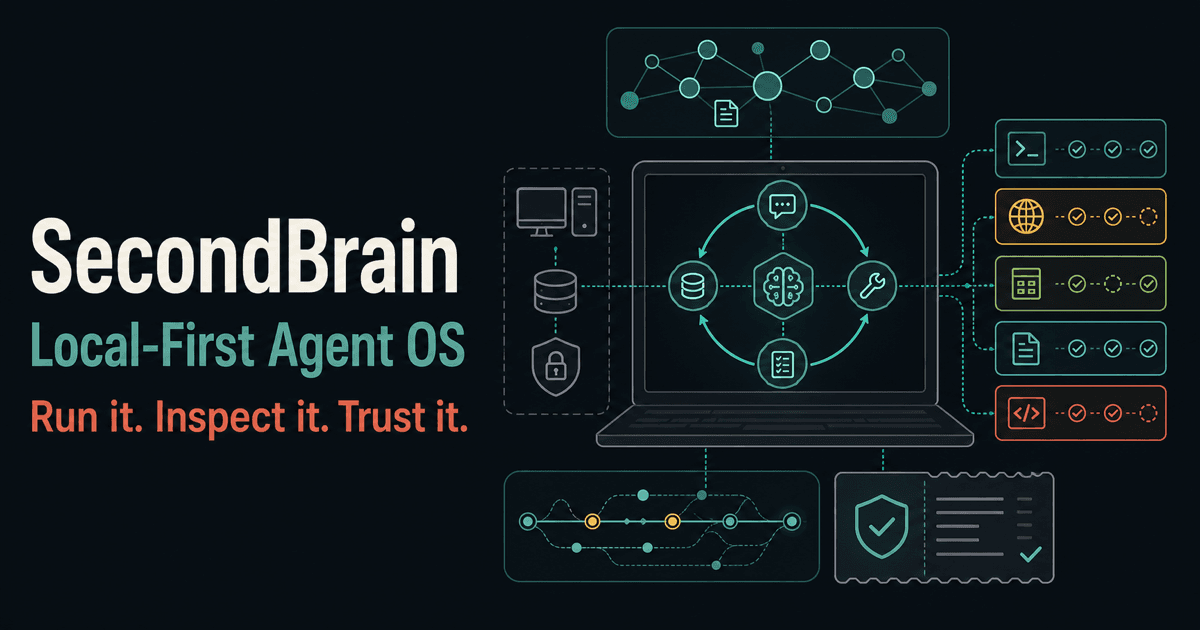
SecondBrain: A Local-First Agent Operating System You Can Run, Inspect, and Trust
SecondBrain is an open-source, local-first agent OS: cognition, memory, governed tools, durable sessions, workflows, and bounded self-improvement in one inspectable runtime you run on your own machine. Here is how it works and how to run it.

Agent Harness: An Architectural Framework for Production AI Agents
A whitepaper on typed contracts, policy gates, traces, verification loops, and release control for production AI agents.

Antahkarana Stack: A Cognitive Layer for Local-First Agents
A builder-facing explanation of Antahkarana as an engineering layer inspired by the inner faculties of Manas, Buddhi, Chitta, and Ahamkara.

The Five Planes of Agentic Operating Systems
A working decomposition for production agent systems: Intelligence, Context, Decision, Action, and Trust.

ContextOS: A Research-Grounded Architecture for Governed Agent Runtimes
A research-grounded framing of ContextOS as the portable decision-control and evidence architecture around governed agent runtimes.

Beyond Prompts: The Architecture of Trust for Agentic AI
Building a governed decision runtime across Intelligence, Context, Decision, Action, and Trust — with evaluator scoring, approval tiers, and replay-bound audit.

Context Engineering in Production
Why most agent failures are not model failures — they are context failures — and what changes when context becomes a versioned, testable, replayable contract.

Context Packs in Practice: From Spec to Run
A practical walkthrough of Context Packs: buckets, policy bundles, evaluation gates, lifecycle, and the compile pipeline.