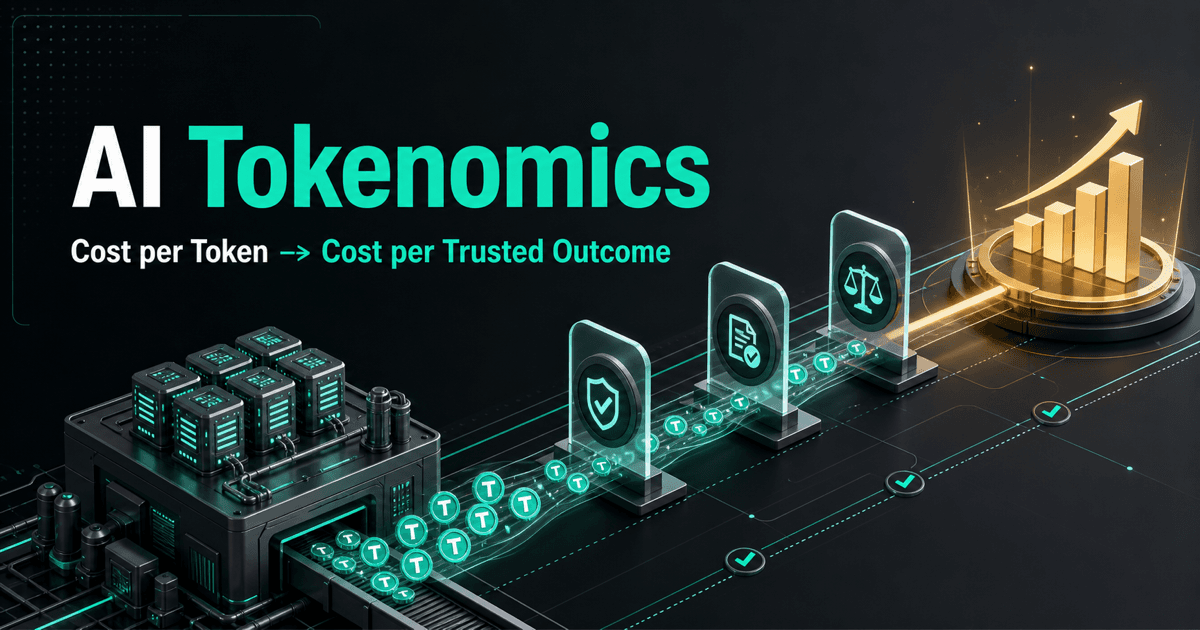
AI tokenomics is not crypto tokenomics.
In this article, tokenomics does not mean crypto-token design. It means the operating economics of AI systems: how tokens are generated, routed, cached, governed, evaluated, and converted into trusted business outcomes.
This is where AI economics, LLM cost optimization, inference economics, AI infrastructure ROI, agentic AI cost, AI observability, evals, and trusted AI outcomes meet. A token is not the product. A trusted business outcome is the product. Tokens are the intermediate units of work consumed to produce that outcome.
The core thesis is simple:
Cost per token is the AI factory metric. Cost per trusted outcome is the enterprise metric. The first optimizes the machine. The second optimizes the business.
That distinction matters because AI-native companies are not just buying model access. They are building operating systems that convert compute, context, tools, policy, evaluation, and human judgment into decisions and actions.
A trusted outcome is not merely a generated answer. It is an AI-produced answer, decision, or action that is:
- grounded in the right context,
- compliant with policy,
- accepted by the user or downstream system,
- observable through logs and evidence,
- and successful against a business or operational objective.
For a support bot, this may mean a resolved ticket. For a coding agent, it may mean a merged pull request. For a travel agent, it may mean a correctly completed booking, cancellation, refund, or itinerary change.
NVIDIA’s AI factory framing is useful because it makes inference economic instead of mystical. NVIDIA describes AI factories in terms of token throughput, performance per watt, cost per token, and token-metered services. That is the right supply-side lens for chips, memory, networking, serving software, and data center productivity. It is not the full enterprise-value lens.
NVIDIA’s framing is useful because it forces AI leaders to stop thinking only in GPU-hour terms and start thinking in production-output terms. But enterprise AI cannot stop at output volume. A token that creates a wrong answer, unsafe action, or failed workflow is not productive output.
A cheap token that hallucinates is expensive. A costly reasoning step that prevents a fraud loss may be cheap. A 20-token structured decision that closes a support case may be more valuable than a 2,000-token answer that creates a reopening. A cached policy block may reduce cost, but stale cached context can damage trust.
Tokenomics is the discipline that connects those layers: demand forecasting, supply efficiency, token mix, context quality, model routing, caching, evaluation, governance, monetization, and margin.
A simple business analogy
A logistics company does not optimize only for fuel cost per kilometer.
That metric matters. Bad fuel efficiency can destroy margins. But fuel cost per kilometer is not the business outcome.
The real metric is cost per successful delivery: the package reached the right customer, on time, without damage, with proof of delivery, and within margin.
In AI:
| Logistics concept | AI equivalent |
|---|---|
| Fuel cost per kilometer | Cost per token |
| Route plan | Agent workflow and model route policy |
| Failed delivery attempt | Retry, repair, or replan token cost |
| Proof of delivery | Evidence, logs, and DecisionRecord |
| Damage or wrong address | Hallucination, policy violation, or wrong action |
| Successful delivery | Accepted trusted outcome |
| Route margin | Gross margin per trusted outcome |
AI tokenomics works the same way. Cost per token is like fuel efficiency: important, but incomplete. Cost per trusted outcome is like cost per successful delivery. It includes the fuel, route, failed attempts, rework, proof, compliance, and final value delivered.
This is why cost per token is necessary but incomplete. It tells you whether the factory is efficient. It does not tell you whether the factory produced a profitable, trusted, business-moving result.
AI factories produce tokens
The first generation of generative AI business cases measured demos. The second measured benchmark scores. The next generation will measure unit economics.
NVIDIA’s technical writing on AI factories frames modern infrastructure as a system for turning power, chips, memory, networking, and software into token output. It also uses metrics such as tokens per watt, tokens per second, revenue per megawatt, and cost per token when discussing factory efficiency and token-metered services.
That framing is directionally right. Reuters Breakingviews has made a similar financial-market point: AI growth is infrastructure-heavy because every query can create new compute and power cost rather than just distributing already-written software.
The important correction is scope:
cost per token = infrastructure productivity
cost per workflow = product operating cost
cost per trusted outcome = business unit economics
An AI factory can become more efficient while the business still gets worse outcomes if the system routes the wrong model, over-retrieves context, skips evaluation, caches stale state, or automates actions without evidence.
The metric: cost per trusted outcome
The phrase “trusted outcome” needs a hard denominator. Otherwise it becomes a slogan.
Cost per Trusted Outcome =
  Total AI Cost for a Workflow
  /
  Accepted, Grounded, Policy-Compliant Outcomes
The numerator is the all-in cost of the workflow:
Total AI Cost =
  model inference cost
+ cached and uncached input token cost
+ output token cost
+ reasoning token cost
+ retrieval and vector search cost
+ tool/API execution cost
+ retry and repair cost
+ evaluation cost
+ observability and logging cost
+ human approval/review cost
+ infrastructure amortization
That all-in cost includes model tokens, tool calls, search, retrieval, vector database cost, guardrail checks, evaluator calls, retries, human approvals, failed attempts, and observability overhead.
The denominator is not “responses generated.” A trusted outcome has conditions:
Trusted Outcome =
  task completed
+ user or system accepted it
+ evidence attached where needed
+ policy checks passed
+ no unsafe or unauthorized action occurred
+ business metric improved or operational work was avoided
That maps to the ContextOS metrics contract. The metric contextos.budget.cost_per_verified_success exists because raw spend is not enough. The denominator must be a verified success, not a request count.
A simple support example makes this concrete. Suppose an AI support agent costs ₹1.20 per interaction. On paper, that looks cheap. But if only 55% of interactions resolve correctly without escalation, the effective cost per trusted resolution is ₹2.18 before adding human review, refund leakage, or customer churn. After better routing, cache reuse, and eval-gated prompts, the per-interaction cost may rise to ₹1.50. If trusted resolution improves to 80%, the cost per trusted resolution drops to ₹1.87. The cheaper token path was not the cheaper business path.
The token P&L
A tokenomics program needs a P&L, not just a token counter.
| Layer | What to measure | Why it matters |
|---|---|---|
| Demand | users, sessions, turns, agent loops | Forecasts load and spend. |
| Token mix | input, cached input, output, reasoning | Different token types have different cost and latency profiles. |
| Context | prompt size, retrieval size, memory injection size | Context is often the silent cost driver. |
| Routing | selected model, fallback model, specialist model | Prevents frontier-model overuse. |
| Runtime | batching, cache hit rate, TTFT, tokens/sec | Determines infrastructure efficiency. |
| Quality | task success, groundedness, hallucination rate | Prevents cheap but useless output. |
| Governance | approval rate, policy violations, blocked actions | Determines whether autonomy is safe. |
| Business | revenue lift, cost saved, conversion, deflection | Connects AI cost to enterprise value. |
| Outcome | accepted trusted outcomes | Becomes the final denominator for ROI. |
This is the difference between token accounting and tokenomics.
Token accounting tells you what you spent.
Tokenomics tells you whether the spend produced durable value.
Not all tokens are equal
The simplest token spreadsheet blends everything into “input tokens” and “output tokens.” That hides the real cost drivers.
There are two ways to classify tokens.
First, classify tokens by accounting class:
| Token class | Why it matters |
|---|---|
| Uncached input tokens | Full prefill cost and latency. |
| Cached input tokens | Cheaper and faster when prompt prefixes repeat. |
| Reasoning tokens | Hidden or partially visible compute used before the final answer. |
| Visible output tokens | User-visible answer or machine-readable action cost. |
| Tool-result tokens | External data injected back into the model. |
| Evaluator tokens | Tokens spent judging or scoring the answer. |
| Retry tokens | Cost from failed, repaired, or low-confidence attempts. |
Second, classify tokens by business quality:
| Quality label | Meaning |
|---|---|
| Grounded tokens | Supported by retrieved evidence or system state. |
| Useful tokens | Help the user or workflow progress. |
| Waste tokens | Verbose, repetitive, or unnecessary. |
| Risk tokens | Unsupported, non-compliant, or hallucinated content. |
OpenAI’s public pricing page separates input, cached input, and output token prices, and many current model examples price output tokens higher than input tokens. OpenAI’s prompt caching docs also explain that repeated prompt prefixes can reduce time-to-first-token latency and input cost when requests hit the cache.
Reasoning tokens need their own line item. Amazon Bedrock’s Claude extended-thinking documentation requires a thinking budget, can increase latency, and explains that full thinking tokens may be billed even when only summarized thinking is returned to the caller. More generally, provider behavior differs: some systems expose full reasoning, some expose summaries, and some expose only usage metadata. Either way, reasoning must be budgeted as a first-class cost and latency driver.
KV and prompt caching need precise language too. They are not generic memory. They reuse previously computed attention state or repeated prompt prefixes, reducing prefill compute, latency, and input-token cost when requests share stable prefixes such as system prompts, tools, policies, schemas, and long context blocks. Cache economics only work when correctness and invalidation work too.
Forecast the agentic multiplier
Simple chatbots are easy to forecast:
users x sessions x average tokens per sessionThat formula fails for agents.
Production AI systems create hidden demand through planner calls, evaluator calls, tool-result summarization, safety checks, retries, repair loops, shadow testing, synthetic testing, background agents, and subagent lanes.
A better first-pass forecast is:
monthly workflow tokens =
  active users
x sessions per user
x turns per session
x average workflow steps per turn
x average tokens per step
x retry factor
x eval factor
x peak traffic factor
A more operational cost version separates token buckets because providers price them differently:
effective token cost =
  uncached input tokens x input token price
+ cached input tokens x cached input token price
+ reasoning tokens x reasoning token price
+ visible output tokens x output token price
+ tool-result tokens x input token price
+ evaluator tokens x evaluator model price
+ retry tokens x blended token price
The important point: token demand is not just visible chat input and output. Agentic systems add hidden reasoning, tool payloads, retries, evaluator calls, memory injection, retrieved context, and policy checks.
One user request can become a planner call, retrieval pass, memory read, tool call, verifier pass, replan, another tool call, policy check, evaluator call, and final answer. The demo measured one visible answer. Production measures the whole run.
The launch question should not be “how many chats will we serve?” It should be:
How many governed workflow steps does one accepted outcome require?
That question changes product design, pricing, rate limits, model routing, approval policy, and infrastructure planning.
Supply levers: do not buy maximum intelligence by default
Token supply is not only a GPU problem. It is the full serving system:
model architecture
+ inference runtime
+ GPU/accelerator
+ memory bandwidth
+ networking
+ batching
+ routing
+ caching
+ quantization
+ scheduling
+ observability
The lesson is not that any one runtime gives a guaranteed multiplier. The lesson is that inference software has become part of the AI factory itself. Batching, routing, KV reuse, structured decoding, speculative execution, quantization, and serving policy can materially change unit economics.
SGLang’s paper, for example, reports runtime optimizations such as RadixAttention for KV-cache reuse and up to 6.4x higher throughput versus state-of-the-art inference systems across several structured language model workloads. That is a research result, not a universal guarantee. But it shows why serving software belongs in the tokenomics conversation.
The same is true for model routing. The FrugalGPT research line showed that cascades can route work across cheaper and more expensive models to reduce cost while preserving or improving quality in specific settings. The lesson is not “always use cheap models.” The lesson is:
Do not buy maximum intelligence for work that only needs narrow competence.
In ContextOS, that is the job of the AI Gateway and LLM Router. The router selects from model profiles under explicit constraints: task type, risk class, latency SLO, data residency, max cost, required capabilities, provider health, and evaluator feedback.
Model routing is the new load balancing. It routes work to the right intelligence tier.
Context is the largest avoidable token cost
Most token waste is not in the final answer. It is in the prompt.
Teams dump the system prompt, full chat history, too many retrieved chunks, broad tool schemas, stale policies, and unranked memory into the model because it feels safer than deciding what belongs.
It is not safer. It is just more expensive and harder to audit.
The Context Pack Compiler exists because a governed runtime needs to know what the model saw and why. It packs context into typed buckets with budgets: business, policy, tool, evidence, memory, and session. If a bucket truncates, the omission is recorded. If evidence is stale, the run should defer or escalate rather than answer confidently.
The tokenomics principle is:
Send the minimum sufficient evidence for the decision, not the maximum available text.
That principle is both an economic control and a trust control.
Tokenomics needs a control plane
In mature AI systems, token cost is not controlled by asking teams to write shorter prompts. It is controlled through a runtime control plane.
That control plane sets budgets and policy across models, context, reasoning, tools, retries, approvals, evaluation, caching, and observability.
| Control | Example |
|---|---|
| Model budget | Use a frontier model only for high-risk or high-value decisions. |
| Context budget | Limit memory and retrieval injection per workflow. |
| Reasoning budget | Cap thinking tokens by task class. |
| Tool budget | Limit tool fan-out and recursive calls. |
| Retry budget | Stop expensive loops after defined failure thresholds. |
| Approval policy | Require human approval for irreversible actions. |
| Eval policy | Run stronger evals only for high-impact outputs. |
| Cache policy | Stabilize prefixes to improve cache hit rate and invalidate when truth changes. |
| Observability | Track cost, quality, latency, and outcome together. |
A serious tokenomics ledger should answer:
| Ledger question | Required artifact |
|---|---|
| Which business workflow consumed the tokens? | workflow_id, intent_id, task type |
| Which model route was selected? | RoutingDecision, model profile, provider adapter |
| Which context was compiled? | ContextPackManifest, pack version, evidence refs, budget report |
| Which tools were called? | ToolCall, ToolResult, idempotency key, approval mode |
| Which checks ran? | evaluator IDs, policy decisions, scorecard |
| What did it cost? | input, cached, output, reasoning, eval, retry, tool, retrieval, human review |
| What was produced? | DecisionRecord, accepted answer, executed action, resolved case |
| Was it trusted? | verifier result, evidence-backed rate, policy-violation state, approval state |
Without that join, token spend becomes invisible. Invisible spend eventually becomes uncontrolled spend.
Use-case examples
The right denominator depends on the workflow.
Customer support
The wrong metric is cost per generated response.
The better metric is cost per correctly resolved ticket without reopening, escalation, refund-policy violation, or customer trust damage.
Coding assistant
The wrong metric is cost per code suggestion.
The better metric is cost per accepted pull request with passing tests, no security regression, and no hidden maintenance debt.
Travel planning agent
The wrong metric is cost per generated itinerary.
The better metric is cost per bookable, policy-safe, inventory-validated itinerary accepted by the user.
Marketing agent
The wrong metric is cost per copy variant.
The better metric is cost per compliant, approved, brand-safe campaign variant that improves click-through rate, conversion, or incremental revenue.
The pattern is consistent: token cost is the input cost. The outcome metric is the value denominator.
Jevons Paradox will show up in AI
Cheaper tokens are unlikely to simply reduce AI bills in serious enterprise deployments. They are likely to make teams spend tokens in more places.
As inference gets cheaper, companies are likely to add more agents, more personalization, more simulations, more evals, more synthetic data, more real-time decisioning, more multimodal workflows, and more internal copilots. That is Jevons Paradox applied to intelligence: when a resource gets cheaper to use, total demand can rise because new uses become economical.
The strategic conclusion is not “cost does not matter.” It is the opposite.
If token demand expands, companies need stronger tokenomics before usage scales: budgets, routing, context compression, caching, eval sampling, approval gates, and cost attribution.
The winning team is unlikely to be the team with the cheapest token alone. It is more likely to be the team that converts cheaper tokens into trusted workflows faster than competitors.
The executive Tokenomics dashboard
The executive dashboard should preserve the hierarchy from infrastructure efficiency to business value.
| Metric | What it tells you | Owner |
|---|---|---|
| Cost per 1M tokens | Raw model and inference economics. | AI platform / infra |
| Cost per request | Average cost of one user interaction. | Product / platform |
| Cost per workflow | Cost of a full multi-step agent execution. | Agent platform |
| Cost per trusted outcome | Cost of a successful, policy-compliant result. | Business + AI platform |
| Tokens per successful outcome | Efficiency of agent and context design. | Agent engineering |
| Retry token ratio | Waste caused by failures, low confidence, or repair loops. | Quality / evals |
| Reasoning token ratio | Cost of test-time intelligence. | Model platform |
| Cache hit rate | Efficiency of context reuse. | Infra / gateway |
| Eval overhead ratio | Cost of trust and verification. | Governance / evals |
| Gross margin per trusted outcome | Whether the AI use case is economically viable. | Business owner |
The ContextOS view
ContextOS treats tokenomics as a runtime discipline, not a prompt-writing discipline.
The AI Gateway and LLM Router govern model choice and model-call telemetry. The Context Pack Compiler governs what enters the prompt and records budget pressure. The Metrics Glossary defines cost, token, success, evidence, latency, replay, and policy metrics by plane. The Evaluation Engine turns quality into a release and operating signal.
That is the operational shape of enterprise AI tokenomics:
Tokenomics =
  demand forecasting
+ supply efficiency
+ context budgeting
+ model routing
+ quality control
+ governance
+ monetization
Cost per token tells you how efficient your AI factory is.
Cost per trusted outcome tells you whether the factory is worth running.
The next generation of AI leaders will not ask only, “How many tokens can our infrastructure produce?”
They will ask:
How many trusted outcomes can our enterprise produce per dollar, per watt, per second, and per unit of risk?
That is the real tokenomics of enterprise AI.
The next generation of AI leaders will not simply buy more GPUs or cheaper model APIs. They will build systems that convert tokens into trusted work: repeatedly, measurably, and governably.
Research base
- NVIDIA: Scaling Token Factory Revenue and AI Efficiency by Maximizing Performance per Watt and Building Token-Metered AI Services on Telco AI Factories for the AI factory, tokens-per-watt, cost-per-token, and token-metered service framing.
- Reuters Breakingviews: AI boom is infrastructure masquerading as software for the infrastructure-heavy economics of AI growth.
- OpenAI: API pricing for separate input, cached input, and output token pricing, and Prompt Caching 201 for repeated-prefix caching, cache hits, and latency/cost impact.
- AWS: Extended thinking for Claude on Amazon Bedrock for reasoning budgets, latency, and thinking-token cost considerations.
- Research systems: FrugalGPT for model cascades, vLLM for high-throughput serving, and SGLang for structured language model runtime optimizations and KV-cache reuse.
- ContextOS docs: AI Gateway and LLM Router, Context Pack Compiler, Evaluation Engine, and Metrics Glossary.