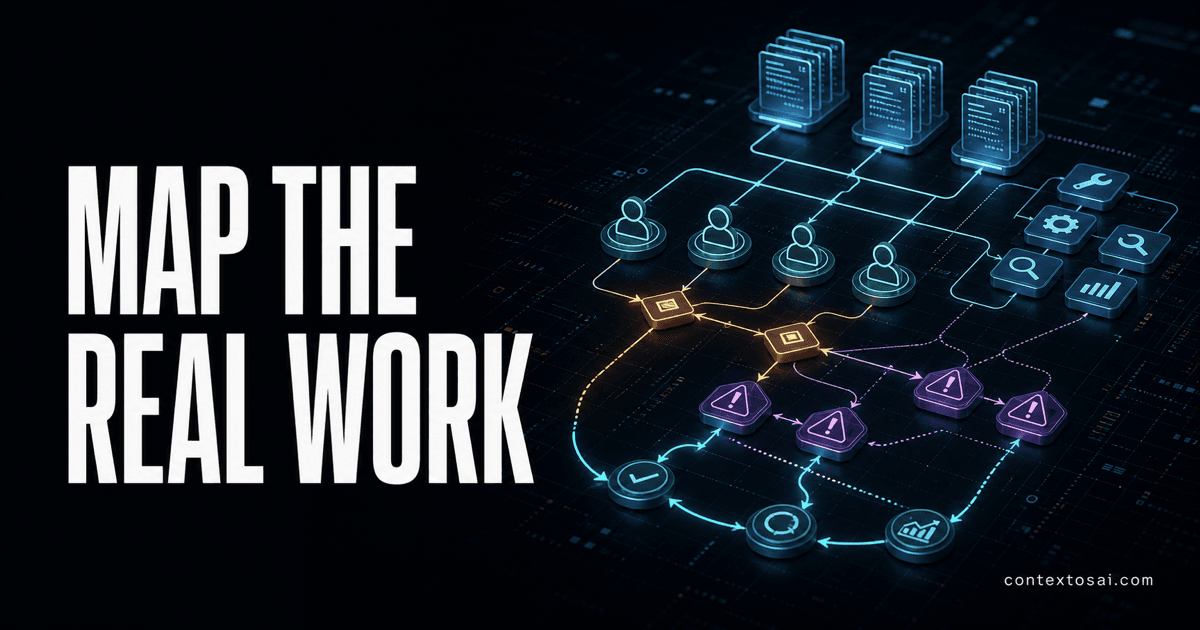
Most AI projects skip the most important step.
They jump from:
This work is painful.
to:
Let’s add an agent.
The missing step is the work map.
If you do not understand how the work happens today, the agent will automate confusion.
The warehouse analogy
Imagine a warehouse.
Packages arrive. Someone checks the label. Someone verifies inventory. Someone moves the package. Someone scans it. Someone handles damaged goods. Someone signs off before high-value items leave.
If you wanted to improve the warehouse, you would not start by buying a robot and saying “move things.” You would map the flow.
Agentic AI needs the same discipline.
The seven-column work map
For every workflow, create this table:
| Step | Human today | Evidence | System touched | Decision | Risk | Exception |
|---|---|---|---|---|---|---|
| Receive request | support rep | customer message | CRM | classify issue | wrong intent | ask clarifying question |
| Check account | support rep | account status | billing system | eligible? | stale account data | escalate to billing |
| Apply policy | policy specialist | refund policy | knowledge base | allow / deny / approve | policy error | human review |
| Execute action | support lead | order + policy | payments | issue refund | money movement | approval gate |
This is not documentation for its own sake. Each column becomes part of the agent system.
Translate the map into AI building blocks
| Work map column | Agent-system building block |
|---|---|
| Step | Task template |
| Human today | Owner or approver |
| Evidence | Context Pack |
| System touched | Tool Gateway |
| Decision | DecisionRecord |
| Risk | Approval mode |
| Exception | Critic verdict or escalation |
This is why operators and domain experts are essential. They know the real workflow, including the messy parts that never appear in process diagrams.
Start with one slice
Do not map the entire company.
Pick one slice:
- one team,
- one recurring workflow,
- one clear business outcome,
- one set of systems,
- one owner,
- one known pain.
Good first slice:
“Resolve subscription cancellation requests where the customer asks for refund eligibility.”
Bad first slice:
“Automate customer success.”
The first can be mapped. The second is too broad.
Find the hidden decisions
Many workflows look like information gathering until you ask better questions.
Ask:
- What are people deciding at this step?
- What evidence makes the decision valid?
- What makes the decision risky?
- What would a good operator refuse to do?
- What gets escalated?
- What gets written down after the decision?
These hidden decisions are the heart of the agentic system.
Name the intent
Once the work is mapped, name the intent.
An intent is a stable name for a class of work.
Examples:
| Vague request | Better intent |
|---|---|
| Help with invoices | finance.invoice.investigate_dispute |
| Handle refunds | support.refund.evaluate_and_execute |
| Onboard customer | customer.onboarding.enterprise |
| Review contract | legal.contract.extract_obligations |
| Answer employee question | hr.policy.answer_with_evidence |
In ContextOS, these live in the Intent-Task Catalog. Non-technical teams do not need to implement the catalog, but they should help name it.
Separate read, draft, and act
One of the most useful work-mapping moves is to label each step:
| Step type | Meaning |
|---|---|
| Read | gather or summarize evidence |
| Draft | prepare something for review |
| Decide | make a recommendation or judgment |
| Act | change the world |
| Escalate | send to a human |
An agent that can read is not the same as an agent that can act.
Most teams should start with read and draft. Add act only after evidence, approvals, and receipts are mature.
Map exceptions before happy paths
The happy path is usually easy.
The exceptions decide whether the system is safe:
- missing evidence,
- conflicting evidence,
- angry customer,
- policy ambiguity,
- tool outage,
- unclear authority,
- high-risk amount,
- possible fraud,
- regulated data,
- customer asks for something outside policy.
Write down what a good human does in each case. That becomes the agent’s escalation behavior.
The work map review
Review the map with:
- the operator who does the work,
- the team lead who handles exceptions,
- the policy owner,
- the system owner,
- the person who receives complaints,
- the person accountable for risk.
Ask each person:
What is missing from this map that would cause a real failure?
That question is better than asking whether they “like the AI idea.”
Done means explainable
The map is ready when a business reviewer can explain:
- what work the agent will do,
- what evidence it needs,
- what systems it may touch,
- what it must not do,
- when it asks for a human,
- what record it leaves behind.
That is enough to start building.