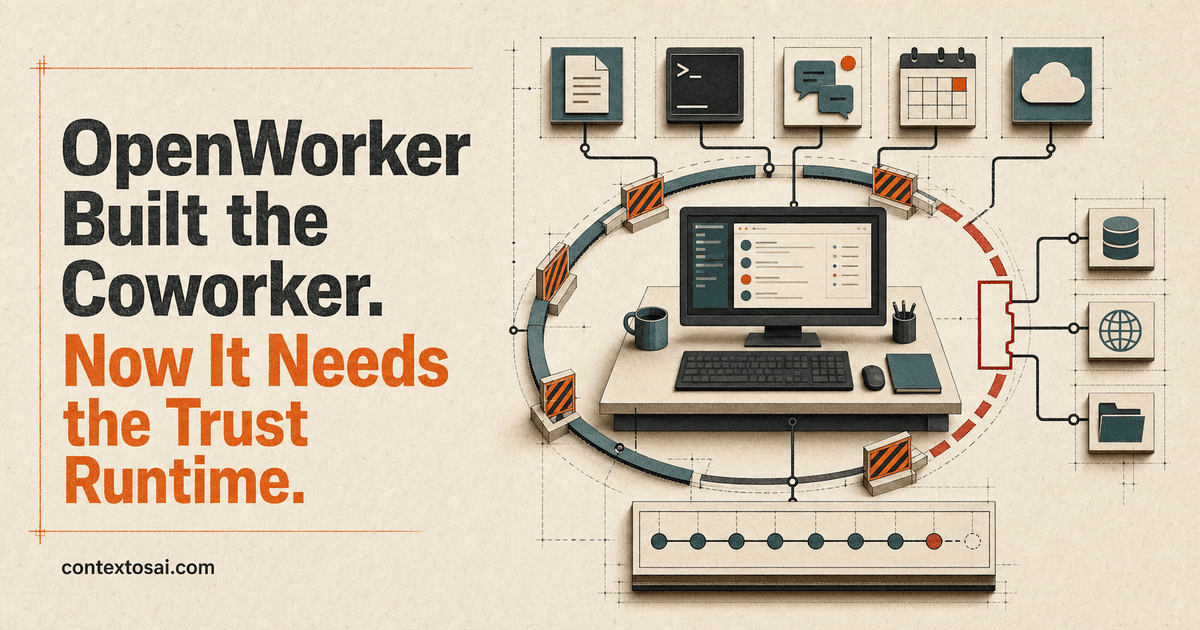
Most desktop AI products still make the user do the real work. They answer a question, suggest a plan, or draft a fragment. The user then moves the result into a document, checks the numbers, opens the right application, sends the message, and remembers what must happen next.
OpenWorker is trying to cross that gap. Its promise is not better chat. It is finished work: a document on disk, a calendar changed, a Slack reply sent, an inbox triaged, or a recurring job completed.
That ambition deserves a serious review because the public code is already more substantial than the usual agent demo. OpenWorker owns its model loop. It has a native desktop surface, a local Python server, model-provider adapters, tools, MCP, connectors, approvals, scheduled runs, durable conversations, compaction, memory, and an audit view. It is a product-shaped runtime, not a prompt wrapped in Electron.
My verdict is therefore deliberately two-sided:
OpenWorker has built a credible personal AI coworker. It has not yet built the full trust runtime required for high-authority, unattended work.
That is not a dismissal. It is the natural next engineering milestone.
Review scope
This review examines the public repository at commit 01b6f83, dated August 1, 2026. OpenWorker identifies itself as an open beta, so this is a snapshot of a fast-moving system, not a permanent verdict.
I reviewed the engine, permissions and risk model, local executor, session persistence, durable resume, memory, audit store, MCP path, secrets, automations, provider layer, desktop configuration, tests, and release workflows. I did not perform a penetration test, inspect the private OAuth broker, or benchmark live model quality. Claims below are therefore about the published architecture and code paths, not undisclosed infrastructure.
The production-readiness scorecard
| Dimension | What exists now | Assessment | Next bar |
|---|---|---|---|
| User value | Desktop app, files, terminal, connectors, Slack, schedules, finished artifacts | Strong beta | Outcome verification, not just artifact creation |
| Runtime ownership | Explicit model/tool loop, streaming, interruption, compaction, provider adapters | Strong beta | Typed run contract and policy snapshot per decision |
| Human control | Interactive approvals, plan mode, standing target rules, unattended inbox | Good foundation | Separate approval from technical containment |
| Model portability | Native and compatible provider adapters, capability matrix, local Ollama path | Promising | Provider conformance and task-level quality gates |
| Durable execution | Persisted conversations, scheduled runs, prompt suspension and resume | Partial | Transactional effect journal and idempotent resume |
| Least privilege | Workspace roots, read-only modes, tool risk classes, workspace trust | Partial | Process, filesystem, network, identity, and data sandboxes |
| Observability | Transcript, token usage, sanitized SQLite audit events | Useful UX | Causal replay packet with hashes, sequence, policy, and outcomes |
| Memory safety | Explicit remember/update/forget tools and scoped SQLite storage | Early | Provenance, review, expiry, contradiction handling, promotion gates |
| Evaluation | Large unit and hermetic UI test surface | Good software testing | End-to-end agent, safety, and provider evals |
| Supply chain | Signed macOS releases, signed updater artifacts, CI and pinned aisuite commit | Mixed | Windows signing, Python lock, SBOM, security scans, release gate |
| Open-source operations | MIT license, issues and pull requests accepted | Early | Public roadmap, security policy, contributor guide, architecture docs |
The scorecard exposes the central distinction: OpenWorker is ahead on product integration and behind on governed effects.
What OpenWorker gets right
It owns the agent loop
The most important architectural choice is the simplest: OpenWorker does not outsource orchestration to a provider. Its TurnEngine owns messages, model calls, tool calls, permissions, interruptions, compaction, and events. It can stream output while running blocking provider and tool work off the async loop. It authorizes all proposed calls, executes low-risk calls concurrently, and preserves call order for consequential work.
That ownership gives OpenWorker room to improve without waiting for any one model vendor. It also makes the repository useful as a readable reference implementation.
It treats approvals as runtime events
OpenWorker’s approvals are not a sentence in the system prompt. The permission engine emits a decision; the turn engine creates a structured request; the UI or unattended inbox resolves it. The engine also distinguishes discuss, plan, interactive, custom, and auto modes, applies path checks to named file writes, rejects shell metacharacters from command-prefix auto-approval, and binds standing connector approvals to an exact target.
This is materially better than the common pattern of asking the model to “be careful.” The permission code is small enough to inspect and deterministic enough to test.
It understands that long-running work needs state outside the model
Conversations are stored as append-oriented JSONL with a SQLite index. Pending questions and approvals can be persisted, answered after a restart, and resumed. Scheduled runs become reopenable conversation threads. Auto-compaction preserves the full local transcript while replacing only the outbound model view with a summary and mechanically extracted working state.
Those are production-minded decisions. They acknowledge that a model context window is not a database and a transcript is not a scheduler.
It is honest about portability
The product supports many providers and local Ollama, but the README says the curated list marks models verified for tool work and that arbitrary model strings are used at the user’s risk. That caveat matters. “Same API shape” does not mean “same agent behavior,” and OpenWorker does not pretend otherwise.
The test surface is real
The reviewed snapshot contains more than a thousand backend test functions plus hundreds of GUI unit and end-to-end cases. The CI workflow runs Python tests, GUI tests, and hermetic Playwright flows. This is unusually strong for a young desktop agent project.
But software tests and agent evaluations answer different questions. That distinction drives several of the improvements below.
Critique 1: approval is not containment
OpenWorker’s README says consequential actions ask first. That is a useful interaction contract, but it can be mistaken for a security boundary.
The current executor is deliberately a native, persistent shell. Its own module says the Executor interface is a hedge for a future container or VM and describes current safety as permission gating, timeouts, and best-effort non-interactive enforcement. In auto mode the permission layer returns “full access”.
Once approved, a shell command runs with the user’s operating-system authority. Workspace path checks on file-edit tools do not constrain what the shell, a child process, a package installer, a repository hook, or a browser session can access. A prompt approval answers “did the user consent to this proposed call?” It does not answer:
- what the process can read after launch;
- what hosts it can contact;
- which credentials it inherits;
- whether child processes escape the workspace;
- whether the displayed command matches every eventual effect;
- whether an indirect dependency executes additional code.
What should improve: ship a contained executor as the default for code and unattended work. At minimum it should enforce mounted roots, read/write distinctions, environment-variable filtering, process limits, a network deny-by-default policy, and an explicit egress allowlist. Keep the local executor for power users, but label it as host-authority execution rather than “full access.”
The key design principle is:
Approval decides authority. A sandbox limits capability. OpenWorker needs both.
Critique 2: four risk classes are too coarse
The risk taxonomy contains read, write_local, exec, and external. Built-in file-edit names and run_shell are classified explicitly. Everything else becomes external only when metadata says it requires approval; otherwise it falls back to read.
This is easy to reason about, but it collapses several different questions:
- Is the call mutating state?
- Is the effect local or remote?
- Is it reversible?
- Which identity and tenant does it act as?
- What data does it read or disclose?
- Does it send, publish, purchase, delete, execute, or change permissions?
- Is the target exact, wildcarded, or model-selected?
- Can retrying it duplicate an effect?
The sharpest example is memory. remember, memory_update, and memory_forget mutate durable cross-session state, yet their metadata declares risk_level="low" and does not require approval. Under the current classifier, those calls are treated like reads. That creates a persistence path through which a mistaken inference—or instruction smuggled through untrusted content—can shape future sessions.
What should improve: replace the single risk enum with a typed effect envelope:
effect:
  operation: update
  domain: memory
  resource: workspace://customer-success/preferences
  target: memory_42
  data_classes: [user_preference]
  external: false
  reversible: true
  idempotency: replace_by_id
  authority: user_local
  approval_policy: propose_then_review
Unknown or incomplete tool metadata should fail closed. Reads should carry sensitivity and egress labels. Memory writes should become proposals with source provenance, confidence, expiry, and review state rather than immediate “low-risk” mutations.
Critique 3: durable conversation is not durable side effects
OpenWorker has thoughtfully implemented durable prompts. On resume, it finds tool calls in the trailing assistant message that lack a tool result and reprocesses them. This works well when the system stopped before execution, such as while awaiting approval.
The dangerous case is a crash after the external effect succeeds but before the tool result is durably recorded. The conversation store appends newly observed messages when save() runs; the persistence path is message-oriented, not a transaction spanning intent, execution, effect receipt, and session state.
Imagine this sequence:
1. Model proposes send_message.
2. User approves.
3. Slack accepts the message.
4. OpenWorker crashes before the tool result is persisted.
5. Resume sees an unanswered tool call.
6. The message may be sent again.
This is not unique to OpenWorker. It is the classic distributed-systems gap between “at least once” execution and an exactly-once user experience.
What should improve: add an effect journal with a stable operation ID before calling the adapter:
PROPOSED -> AUTHORIZED -> DISPATCHING -> COMMITTED -> VERIFIED
                            |                |
                            +---- UNKNOWN ---+
Every consequential adapter should accept or derive an idempotency key. On restart, UNKNOWN effects should be reconciled against the target system before retry. For APIs without idempotency support, OpenWorker should surface an operator decision with the original target, payload hash, and best-known receipt.
Do this before expanding unattended automation. Durable scheduling without durable effects can make the same mistake more reliably.
Critique 4: the audit log is useful, but it is not replay
OpenWorker records tool stage, status, approval, sanitized arguments, a result preview, a reason, and a resource in SQLite. It redacts obvious secret and body fields and truncates long values. That is a sensible operator-facing audit view.
For forensic replay, however, the current schema omits several load-bearing facts: event sequence, run ID distinct from session, exact model and provider version, rendered prompt or context hash, tool schema hash, policy snapshot, approval actor, effect ID, idempotency key, before/after state, verification result, and artifact digest. The audit store deliberately keeps 500-character previews, and the engine treats audit writes as best effort.
That makes the log good for answering “what tool appeared to run?” It is not enough to answer “can we reconstruct why this exact action happened under this exact authority, prove what changed, and safely replay the decision against a controlled environment?”
What should improve: emit an append-only, sequence-numbered run ledger. Store large payloads and artifacts separately by content hash; keep the event log compact. A replay packet should bind:
- immutable run and decision IDs;
- principal, tenant, workspace, and delegated identity;
- model/provider and tool-manifest versions;
- selected context with source lineage;
- policy and approval snapshots;
- tool arguments and normalized results;
- effect receipts and verification evidence;
- budgets consumed;
- final outcome and evaluator verdicts.
Redaction and replay are not opposites. Sensitive content can be encrypted or access-controlled while hashes and manifests remain available for integrity checks.
Critique 5: local-first is topology, not a complete privacy model
OpenWorker deserves credit for keeping the loop, conversations, and credentials local and for allowing signed-out use. It also clearly discloses that data leaves through selected models and integrations and that managed OAuth uses a cloud broker.
But “local-first” can still sound stronger than the actual data-flow guarantee. A model request may contain user messages, retrieved file content, connector results, memories, summaries, and tool schemas. A web or connector result can influence a later call to another system. A local process can still exfiltrate data over the network. Managed relays introduce another transport boundary.
The secret-store implementation is careful about file permissions and excluding values from model context, but v1 is explicitly a 0600 JSON file, not an encrypted OS credential vault.
What should improve: make the privacy boundary inspectable:
- Show a per-run egress manifest: destination, data classes, reason, and policy.
- Add a hard local-only mode that disables every network path except explicitly selected local endpoints.
- Label tool results by provenance and trust; prevent untrusted content from silently becoming instructions.
- Add cross-domain flow rules, such as “email content may inform a draft but may not trigger credential, file-upload, or payment tools.”
- Move tokens to Keychain, Credential Manager/DPAPI, or another encrypted backend while retaining environment-variable references for advanced users.
- Publish a threat model for the desktop app, OAuth broker, relay, updater, model providers, MCP servers, and connector identities.
Local-first should become a verifiable policy profile, not only a deployment description.
Critique 6: the registry needs a context and tool compiler
OpenWorker has good progressive disclosure for skills and only registers enabled connector tools. Yet on every provider call the engine sends self.registry.schemas(): the full tool surface currently attached to that engine.
As users enable more connectors, schedules, memory tools, messaging paths, MCP servers, and persona features, the manifest grows. More schemas cost tokens, reduce prompt-cache stability, increase name collisions, and give the model more irrelevant affordances. A permission prompt after selection does not prevent the model from choosing the wrong tool or spending turns exploring an oversized menu.
What should improve: compile the smallest valid context and tool pack for each decision. Selection should consider the active intent, persona, current step, connected accounts, data policy, directory scope, approval mode, model capabilities, and remaining budget. Record why every tool was included or excluded.
This is not merely an optimization. Smaller tool surfaces reduce accidental authority and prompt-injection blast radius.
Critique 7: an iteration ceiling is not an autonomy budget
The runtime has an iteration cap and individual tool timeouts. The standard app configuration allows up to 150 iterations. Token usage is displayed, and context compaction prevents overflow.
What is missing is a run budget that governs the resources an autonomous task may consume: model tokens, estimated cost, elapsed time, tool calls, network calls, bytes disclosed, external mutations, subagent work, retries, and approval debt. A 150-iteration ceiling answers only one of those questions, and it does so after consumption.
What should improve: add typed budgets with reservation and settlement:
budget:
  wall_clock_seconds: 900
  model_input_tokens: 250000
  model_output_tokens: 30000
  tool_calls: 80
  external_mutations: 3
  network_egress_mb: 25
  estimated_cost_usd: 5.00
Before a model or tool call, reserve capacity. After completion, settle actual usage. On exhaustion, checkpoint the run with a typed stop reason and a safe continuation path instead of merely ending after the next loop comparison.
Critique 8: tests do not yet prove coworker quality
The repository’s unit and UI coverage is a strength. It verifies provider translation, permission decisions, persistence, connector plumbing, UI states, and many regressions.
It does not yet answer the product question: does this model-plus-harness reliably finish representative work without unsafe or wasteful behavior?
A provider adapter can pass every schema-conversion test while a model still chooses the wrong tool, loops, sends an under-evidenced answer, mishandles an injected instruction, or produces a polished but incorrect artifact.
What should improve: add a versioned, replayable task-evaluation suite across verified models. It should include:
- multi-source research with citations and contradiction handling;
- document and spreadsheet deliverables checked by deterministic validators;
- calendar and messaging tasks with reversible fake connectors;
- prompt injection inside email, web pages, files, MCP descriptions, and prior memory;
- crash points before and after consequential effects;
- approval-quality tests: sufficient explanation, exact target, meaningful diff, no dark patterns;
- long sessions that compact and resume;
- provider-switch degradation;
- cost, latency, tool precision, completion rate, leak rate, duplicate-effect rate, and human-intervention rate.
The release gate should compare a candidate harness to the last trusted version by model and scenario slice. “All software tests pass” and “the coworker got better” are separate claims.
Critique 9: release security and project governance trail the blast radius
OpenWorker is a desktop application that holds connector tokens, runs shell commands, accesses files, and auto-updates. Its supply-chain bar should therefore be higher than that of a normal chat UI.
The release workflow signs and notarizes macOS builds and signs updater artifacts, which is good. The README also clearly says Windows builds are not yet code-signed. Python dependencies use broad lower bounds and the repository snapshot has no Python lockfile; aisuite is pinned to a commit, but the remaining environment is not reproducible from a resolved manifest. The public CI runs tests but not a documented lint, type, vulnerability, secret, SAST, SBOM, or provenance gate.
The community contract is similarly thin. The README welcomes pull requests while saying development follows an internal list and goal. It describes docs/ as design specs and decision logs, but in the reviewed docs/ tree that directory contains only the architecture image and a configuration example. I also found no public SECURITY.md, contributor guide, roadmap, or threat model in the repository tree.
What should improve: before widening distribution or auto-update reach:
- sign Windows installers;
- lock Python production and build dependencies;
- produce an SBOM and provenance attestation per release;
- add dependency, secret, static-analysis, and updater-integrity gates;
- pin third-party CI actions by immutable digest;
- publish a vulnerability-reporting policy and supported-version window;
- document architecture, trust boundaries, data flows, extension contracts, and release decisions;
- expose a small public roadmap so contributors can work with, rather than around, the internal plan.
Open source is not only readable source. For a high-authority agent, it also needs an operable trust relationship with users and contributors.
A concrete improvement roadmap
The improvements should land in risk order, not feature order.
P0: before broad unattended authority
- Contain the executor. Default-deny filesystem and network access; filtered environment; child-process and resource limits.
- Introduce typed effects. Fail closed on missing metadata; distinguish sensitivity, reversibility, identity, target, and idempotency.
- Journal every consequential effect. Stable operation IDs, prepared/committed/verified states, adapter receipts, reconciliation on restart.
- Govern memory writes. Provenance, proposal state, approval rules, expiry, contradiction checks, and rollback.
- Add egress policy. Per-run manifest, local-only profile, data-class and cross-domain flow enforcement.
- Harden credentials and distribution. OS-backed secret storage, Windows signing, security policy, locked builds, SBOM.
P1: make reliability measurable
- Build the task-eval harness. Representative datasets, deterministic checkers, safety attacks, provider slices, regression replay.
- Create replay packets. Causal event sequence, context and policy hashes, effect receipts, evaluator results.
- Compile tools per decision. Intent-aware discovery with explicit inclusion reasons.
- Enforce autonomy budgets. Tokens, cost, time, effects, retries, data egress, and subagent limits.
- Verify outcomes. A “sent” API response is not the same as the right person receiving the right message; a file existing is not the same as a correct deliverable.
P2: turn the repository into a platform
- Publish the architecture, threat model, extension SDK contract, and data-flow diagrams.
- Add connector conformance tests and a capability manifest.
- Add team policy profiles without weakening the local-first personal mode.
- Publish a roadmap, contribution guide, governance rules, and release support policy.
- Add evidence-based memory promotion and cross-session learning rather than direct accumulation.
What I would not change
OpenWorker should not respond to these critiques by becoming a cloud-only orchestration service or by hiding its runtime behind a proprietary API.
Keep:
- the local control plane;
- bring-your-own-model support;
- signed-out operation;
- the explicit, inspectable agent loop;
- the approval inbox and plan-to-execute handoff;
- the provider adapters;
- the readable Python core;
- the bias toward finished artifacts.
Those are the project’s strategic advantages. The right move is to surround them with stronger deterministic controls.
The practical verdict
Today, I would use OpenWorker for attended, recoverable, personal work in a constrained folder, with a trusted model provider, interactive approvals, and connectors whose effects I can inspect and undo.
I would not yet give it broad unattended shell access or authority over irreversible, regulated, financial, security-sensitive, or high-volume workflows. The missing pieces are not more agent cleverness. They are containment, effect durability, data-flow policy, replay, budgets, and evaluation.
That is why OpenWorker is worth paying attention to. It has already crossed the difficult product boundary from “answer” to “work.” If it now crosses the runtime boundary from “approval-gated” to governed, replayable, and verifiably bounded, it could become one of the more important open desktop-agent projects—not just a useful beta.