On July 18, 2026, Peter Steinberger asked on X, “Are we still talking loops or did we shift to graphs yet?” [7] A same-day X Article declared “Loop Engineering Is Dead” [10]; four days later LangChain called graph engineering the latest term from X’s AI content factory while noting that LangGraph had used the model for years [11]; on July 30 a preprint proposed a four-condition definition [6]. In twelve days, the phrase moved from provocation to repetition, vendor absorption, and formalization.
The architecture is older. AI Chains decomposed LLM work into modular prompt steps in 2022 [1]; DSPy described language-model pipelines as compilable text-transformation graphs [2]; StateFlow represented tool-using work as a state machine [3]; LangGraph and AutoGen expose graph execution directly [4, 5]. What changed is what runs inside a node: probabilistic workers can interpret underspecified goals, choose tools, create artifacts, and alter downstream information. A transition can now mean, “a model found the result incomplete, so fan out, join, verify, and either revise or request approval.”
That makes topology a product decision. The graph determines who works, what each node can see, which outputs can block or authorize the next step, how parallel work rejoins, when cycles stop, and which failures become visible.
But topology is not the hard part.
Graphs are easy to draw. Governed transitions are hard.
The durable problem is not connecting SOURCE to TARGET. It is making four independent transition questions executable without letting an ordinary arrow smuggle authority:
This is the article’s signature framework: graph families describe the system; transition semantics govern influence. The families are execution, message, knowledge, and lineage. The transition semantics are control, data, context, and authority—with authority checked afresh rather than inherited from the source node.
The durable definition is:
Graph engineering is the discipline of representing agent work as an explicit, executable, versioned graph whose nodes and edges have testable contracts.
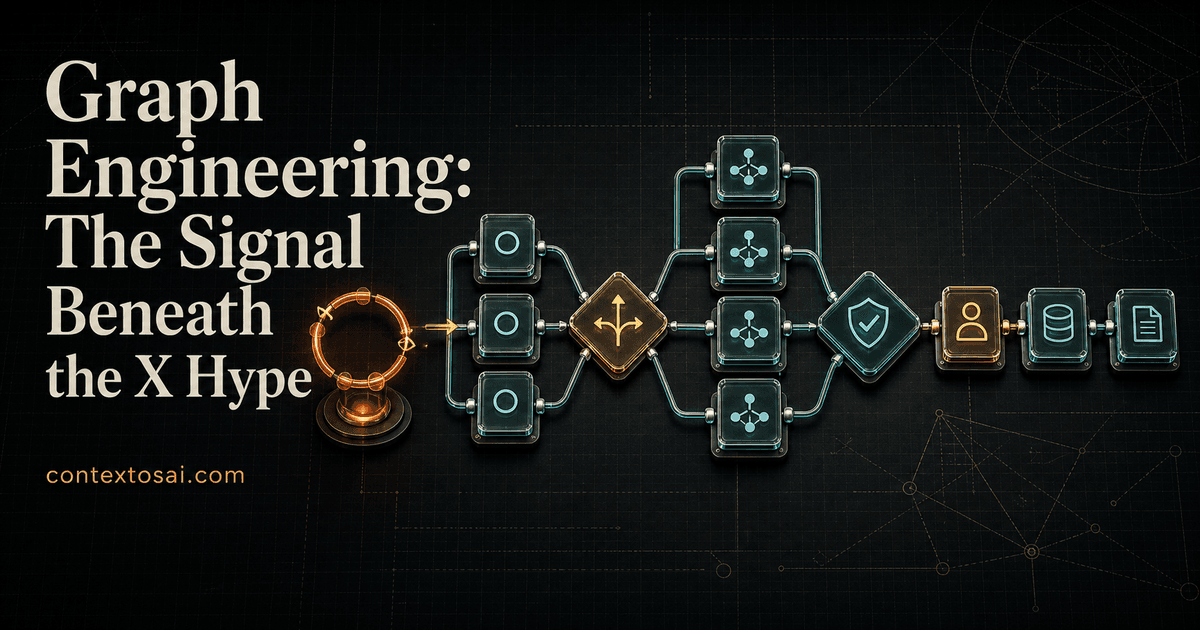
Use one concrete graph as a running example. It contains fan-out, an assurance join, a bounded revision edge, a human authority gate, an external effect, and a terminal record:
A diagram is not enough. A graph is engineered only when the runtime can execute it, the team can validate it, and a past run can explain which path it took.
I. The X hype cycle, reconstructed
The July wave did not originate the phrase. Itamar Friedman wrote about a shift from prompt engineering to “flow (/graph) engineering” in February 2024 [8]. One week before Steinberger’s post, Mike Masson published the ladder that X would soon repeat: prompt, context, harness, loop, then graph engineering [9]. Steinberger amplified a label that was already available.
| Date | Observable event | What it actually established |
|---|---|---|
| February 29, 2024 | ”Flow (/graph) engineering” appears in an agent-systems discussion [8] | The phrase family predates the 2026 wave |
| July 11, 2026 | The prompt → context → harness → loop → graph ladder appears on X [9] | The label was positioned as the next abstraction layer |
| July 18, 2026 | Steinberger asks whether the discourse has shifted from loops to graphs [7] | A memorable trigger, not a technical release |
| July 18, 2026 | Same-day long-form explainers recast graphs as the successor to loops [10] | The expansion phase of the hype cycle |
| July 22, 2026 | LangChain publishes “3 Years of Graph Engineering with LangGraph” [11] | Established tooling absorbs and qualifies the new term |
| July 30, 2026 | Macedo proposes four necessary conditions in a preprint [6] | A provisional definition, not peer-reviewed consensus |
This timeline matters because it separates social novelty from technical novelty. No graph runtime suddenly became possible on July 18. The useful shift is narrower: capable agent runs can now sit inside nodes, so engineers increasingly need to design the relationships among several probabilistic workers, deterministic transforms, tools, reviewers, and human gates. LangChain’s own retrospective makes both points: the graph model is established, while putting a full coding or research agent inside a node is newly practical [11].
The hype filter is simple:
| Timeline claim | Verdict | Production question |
|---|---|---|
| ”Graphs replace loops” | False: production graphs usually contain cycles, and a loop is a simple cyclic graph | Which cycles exist, and what forces each one to stop? |
| ”More agents make a better graph” | False: nodes may be agents, model calls, tools, gates, or deterministic code | Does every node own a distinct contract or failure boundary? |
| ”A graph makes an agent reliable” | Incomplete: topology only exposes where reliability controls belong | Are joins, retries, approvals, effects, and terminal states testable? |
| ”The workflow should be a versioned artifact” | Signal: this is the operationally important claim | Can the graph be diffed, replayed, evaluated, promoted, and rolled back? |
Treat the term as a prompt to inspect hidden control flow, not as permission to redraw a working loop. If the current system has one objective, one context boundary, one authority boundary, and one measurable stop condition, keep the loop.
II. What graph engineering is
First, disambiguate the graphs
Agent systems contain several graphs that answer different questions:
| Graph | Nodes | Edges | Question answered |
|---|---|---|---|
| Execution graph | tasks, model calls, tools, gates, deterministic transforms | control and data dependencies | What runs next? |
| Message graph | agents or lanes | permitted information flows | Who can tell whom what? |
| Knowledge graph | entities, facts, policies, events | typed domain relationships | What is known and how is it related? |
| Decision-lineage graph | runs, evidence, policies, approvals, effects | used, approved, caused, wrote | Why did this action happen? |
The current “graph engineering” discussion mostly means the execution graph. Collapsing the other three into it creates dangerous ambiguity.
An edge from a researcher to an executor might mean any of these:
- the executor may start after research completes;
- the executor receives the researcher’s entire message history;
- the executor receives one evidence bundle;
- the researcher is allowed to authorize the executor’s tool call.
Those are four different contracts. The last one should almost never be implied by an ordinary edge.
AutoGen’s GraphFlow documentation makes one separation explicit: its execution graph controls the order in which agents run, while message filtering separately controls which messages they receive [5]. GraphFlow is a useful implementation example, but its official documentation labels it experimental and warns that its API and behavior may change.
The two taxonomies operate at different levels. Execution, message, knowledge, and lineage are system-level graph families. Control, data, context, and authority are orthogonal edge semantics that may appear within or between those graphs. A framework may draw them on one canvas; the runtime still needs to distinguish them.
From prompt to chain to loop to graph
The progression is useful if we resist turning it into a maturity ladder.
| Structure | Best at | Fails when |
|---|---|---|
| Prompt | one bounded transformation | the task needs tools, verification, or state |
| Chain | known sequential decomposition | results require branching or revision |
| Loop | iterative work toward a local stopping condition | several loops have dependencies or conflicting objectives |
| Graph | parallel, conditional, multi-stage work with explicit joins | the topology becomes more complex than the task requires |
A graph is not the next rung after a loop: cycles are subgraphs, and one revision loop may sit beside parallel reviews and a human gate. Nor does a graph imply one agent persona per node; the same model, deterministic transforms, tools, and humans can occupy differently scoped nodes. Use the simplest structure that expresses real dependencies. AutoGen recommends structured graph execution for strict ordering, conditional branches, or complex cycles—not every chat [5].
A useful boundary—and where production systems must go further
A July 30, 2026 preprint by Sandeco Macedo proposes four conditions for “prompt graph engineering” [6]. It is new and not peer-reviewed, but it gives the category a useful inclusion test:
| Boundary condition | Practical test |
|---|---|
| Explicit structure | Nodes and edges exist outside a model’s prose |
| Structure/content separation | Prompts can change without silently rewriting topology |
| Executable semantics | Edges define schedulable predicates, joins, retries, or terminal outcomes |
| First-class artifact | The graph has identity, version, history, evaluation, and rollback |
That boundary says what qualifies as a prompt graph. Production graph engineering starts where qualification ends:
The distinction matters for originality and for operations. The four conditions identify a graph-shaped engineering artifact; they do not settle authority isolation, durable side effects, ambiguous completion, invariant checking, path evaluation, or version promotion. Those are the production control-plane problems this article addresses.
III. How to design a graph
Separate the graph definition from each instance
The four-condition test does not require every node to be statically authored before a run. It requires the runtime-owned structure to remain explicit and constrained when a model proposes a plan.
| Artifact | Owns |
|---|---|
| Graph definition | permitted node/tool types, legal transitions and mappings, authority and budget ceilings, mandatory gates, veto owners, terminal states, and convergence rules |
| Graph instance | instantiated nodes, selected branches, fan-out cardinality, generated subtasks, resolved dependencies, budgets consumed, and terminal path for one request |
A model may propose a graph instance, but it may not invent new authority, node classes, effect types, or bypass paths outside the validated graph definition.
Validate an instance before scheduling it: every generated node must resolve to an allowed class, every edge to a legal transition, every cycle to a budgeted convergence contract, and every effect path to its mandatory gate. Dynamic planning then becomes bounded topology selection, not runtime self-authorization.
Compile the graph before executing it
“Validate the generated graph” is too weak if validation is an ad hoc runtime callback. Treat graph construction as compilation through four distinct forms:
- Authoring graph: declarative topology optimized for humans and planners.
- Compiled graph: capabilities resolved, policy bound, schemas checked, mandatory gates inserted, and ceilings fixed.
- Run graph: the actual nodes, fan-out, selected branches, budgets, and routes for one request.
- Lineage graph: the immutable account of evidence used, decisions made, approvals granted, and effects committed.
The security property is concise: the model may propose topology; the compiler decides whether it is executable. Compilation must not add authority merely because a proposed node asks for it.
Make graph invariants first-class
Before a compiled graph becomes schedulable, static validation should prove or conservatively reject invariants across every reachable path:
| Invariant family | Example production assertions |
|---|---|
| Structural | a terminal state is reachable; no orphan nodes; every cycle is bounded |
| Authority | ordinary edges cannot increase capability; approval gates cannot be bypassed |
| Information | prohibited context cannot cross an edge; required provenance cannot disappear |
| Assurance | required veto lanes cannot be skipped; timeout or absence cannot become approval |
| Effect | every effect has a stable intent/effect id and the required idempotency or compensation contract |
| Budget | every reachable path has a bounded worst-case token, time, tool, and cost envelope |
Some properties are statically decidable; others require conservative bounds or a review obligation. The important behavior is fail-closed: an unproved authority or effect invariant does not become permission to run.
A practical first-week retrofit
Do not begin by selecting a graph framework or inventing an agent org chart. Begin with one working loop and a replayable slice of its real runs.
- Collect 20–50 representative traces: successes, stalls, expensive runs, human rescues, and correct refusals.
- Mark structural pressure: real branching, joins, authority boundaries, review cycles, or interrupted work. If none exists, keep the loop.
- Externalize one risky boundary: draft → review, proposal → approval, or plan → effect. Do not turn every prompt into a node.
- Define the state envelope: typed artifact and evidence references; explicit missing, stale, rejected, and timed-out states.
- Make routing replayable: deterministic policy predicates; persisted model verdicts, inputs, model version, and graph version.
- Bound the first cycle: iteration, token, time, and cost caps plus success, failure, no-progress, and escalation exits.
- Replay against the loop: compare outcome, path success, cost, latency, intervention, and policy failures before promotion.
The first graph release should be boring: one explicit branch or gate, one checkpoint before an effect, one bounded retry, and four path fixtures—success, refusal, timeout, and recovery. Complexity should arrive as measured pressure, not as boxes drawn in advance.
One definition, one run, one exact replay
Here is the running example as a compact, executable-shaped contract. The syntax is illustrative; the semantics are the point.
Graph definition
graph_id: production_change
version: 12

review_lanes:
  security: {required: true, veto: true}
  reliability: {required: true, veto: true}
  architecture: {required: false, veto: false}

join:
  activation: all_required
  absence_is_approval: false

cycle:
  edge: reliability_review -> draft_change
  max_iterations: 2
  reentry_requires: new_evidence

effect:
  capability: code.merge
  approval: always
  effect_id: required
  evidence_snapshot: frozen_at_approval
  idempotency: downstream_enforced
Run graph instance
run_id: run_9821
graph: production_change@12

nodes:
  planner: completed
  research: completed
  security_review: pass
  reliability_review: pass
  architecture_review: missing_timeout
  assurance_join: eligible
  human_approval: approved
  execute_effect: committed
  decision_record: complete

join_record:
  required_received: [security_review, reliability_review]
  advisory_missing: [architecture_review]
  decision: eligible_for_human_approval

effect_record:
  effect_id: effect_77b9
  downstream_commit_id: merge_4815
  receipt_status: persisted
Exact replay record
replay_of: run_9821
graph: production_change@12
model_verdicts: pinned
tool_results: recorded
deterministic_predicates: recomputed
effect: stubbed_from_commit_receipt
result: MATCH
This artifact makes three distinctions concrete. The definition owns permitted structure. The run graph records what was instantiated and selected. The replay recomputes deterministic policy while reusing nondeterministic verdicts and external receipts. Recalling a model or external tool would create a new experiment, not an exact replay.
Design node contracts before drawing edges
Most graph failures begin with vague nodes. “Research,” “analyze,” and “review” sound clear on a whiteboard but say nothing about admissible inputs, outputs, authority, or completion.
An engineered node needs at least:
| Contract surface | Required decision |
|---|---|
| Identity | stable node_id, version, owner, purpose |
| Input | typed fields, source lineage, freshness and integrity requirements |
| Output | schema, terminal statuses, evidence and artifact references |
| Context | pack or prompt version, visible messages, memory eligibility |
| Capability | model, tools, filesystem or network scope, approval mode |
| Budget | tokens, cost, time, attempts, child work |
| Idempotency | whether and how the node can safely resume or repeat |
| Evaluation | local checks and downstream acceptance criteria |
| Failure | retry, compensate, escalate, or terminate |
The node should produce a typed verdict, not make downstream code parse persuasive prose for words like “approved.”
An illustrative article schema:
type NodeVerdict =
  | { status: "completed"; artifact_refs: string[]; evidence_refs: string[] }
  | { status: "needs_revision"; reasons: string[]; evidence_refs: string[] }
  | { status: "blocked"; missing: string[] }
  | { status: "rejected"; policy_decision_id: string }
This is illustrative, not a new ContextOS public type. In production, bind each node to the canonical Run Context, capability manifest, policy decision, budgets, and approval contract. Keep effect level, execution scope, authority source, approval policy, and reversibility as independent dimensions; a single label such as network or destructive cannot express their combinations.
Edges carry more risk than arrows suggest
An edge is a policy about transition and influence. Specify:
- source and target node ids;
- trigger verdict or typed predicate;
- data mapping from source output to target input;
- activation semantics for multiple parents;
- context visibility and redaction;
- deadline, expiry, and cancellation behavior;
- whether the transition consumes retry or cost budget;
- which record proves the transition was eligible.
The condition should evaluate structured state, not unconstrained text:
edge:
  id: draft_to_security_review
  from: draft_change
  to: security_review
  when:
    all:
      - path_changed: "src/auth/**"
      - draft_status: completed
  map:
    patch_ref: output.patch_ref
    evidence_refs: output.evidence_refs
  context:
    include_messages: false
    include_artifacts: [patch_ref, evidence_refs]
  activation: all
This edge does not give the reviewer the writer’s entire conversation. It passes the patch and evidence needed for the review. Context minimization reduces correlated mistakes, irrelevant instruction carryover, and token pressure.
Most importantly, edges do not transfer authority by default. In the running graph, the Research node can supply evidence to Draft; it cannot confer the authority later used by Execute effect. The child node’s effective capabilities are re-derived from its own identity, policy, effect classification, authority source, reversibility, and approval state.
Joins are decision points
Parallelism is the obvious benefit of a graph. Joins are where parallel systems quietly become unreliable.
Consider the running graph’s security and reliability reviewers. When should the assurance join run?
all: wait for every reviewer;any: proceed after the first response;quorum(3): proceed after three;all_required + optional: security and reliability are mandatory, product is advisory;first_success: useful for redundant retrieval, dangerous for assurance;deadline: proceed with an explicit incomplete state after time expires.
The correct semantics depend on the risk, not on which join primitive is convenient.
Never collapse absence into approval. In the canonical graph, a timed-out security reviewer is missing, not pass; the annotated timeout behavior is part of the edge contract. Never reduce heterogeneous verdicts to majority vote when one lane owns a veto. Never merge two outputs without preserving which evidence and graph version produced each one.
Joins should emit their own record:
{
  "join_id": "release_gate_join",
  "required": ["security", "reliability"],
  "received": ["architecture", "security", "reliability"],
  "missing": ["product"],
  "vetoes": [],
  "activation": "all_required",
  "decision": "eligible_for_human_approval"
}
That makes partial completion visible and replayable.
Every cycle needs a convergence contract
Loops inside graphs are useful for revision, search, incident recovery, and tool retries. They are also the easiest way to turn a graph into a token furnace.
A cycle needs:
- a local objective;
- a measurable progress signal;
- a maximum iteration, time, token, and cost budget;
- a no-progress detector;
- a stable checkpoint before re-entry;
- an exit for success, failure, and escalation;
- a rule for what new evidence permits another attempt.
“Try again until the reviewer approves” is not a convergence contract. The reviewer may prefer a different style on every pass. In the running graph, the reliability-to-draft revision edge allows at most two passes and requires new evidence; the runtime should also stop when the score is unchanged, the budget is exhausted, or the candidate regresses on a safety floor.
StateFlow’s useful distinction is between process grounding—states and transitions—and subtask solving inside a state [3]. Keep deterministic loop guards in the first category. A model may propose whether a draft addressed the feedback; the runtime still owns the iteration cap and terminal transition.
IV. How to operate a graph
Checkpoint intent; make effects resumable
Graph execution becomes operationally different from a chain when branches run for minutes or hours, call tools, and resume after failure. Durable execution requires checkpoints with enough state to continue without repeating completed effects.
Checkpoint at least:
- graph id and version;
- current node instances and attempt numbers;
- admitted input and artifact hashes;
- completed verdicts;
- pending joins and missing parents;
- token, cost, and wall-clock budgets used;
- tool calls, idempotency keys, and commit receipts;
- approvals and evidence snapshot hashes;
- cancellation or supersession state.
LangGraph checkpointers persist graph-state snapshots for interruption recovery, fault tolerance, and human-in-the-loop workflows [12]. That durability is necessary, but a workflow checkpoint alone cannot make an external effect exactly-once.
Consider the ambiguity window:
persist pre-effect checkpoint
        ↓
call external service
        ↓
external service commits
        ↓
worker crashes before receipt persistence
On resume, the graph knows the intent was admitted but does not yet know whether the downstream system committed it. Temporal documents the same distributed-systems edge case: an activity may complete, the worker may crash before reporting completion, and the activity may execute again. Its recommended idempotency key is enforced by the called service—not by the workflow runtime [13].
The complete effect protocol is therefore:
propose
  ↓
freeze intent + stable effect_id
  ↓
approve(effect_id, evidence_snapshot)
  ↓
execute(effect_id as downstream idempotency_key)
  ↓
receive downstream commit identity
  ↓
persist receipt
  ↓
reconcile ambiguous completion when necessaryview source
sequenceDiagram
    participant R as Graph runtime
    participant S as External service
    R->>R: Persist intent, effect_id, approval snapshot
    R->>S: Execute(effect_id)
    S->>S: Commit effect
    Note over R,S: Worker crashes before receipt persistence
    R->>S: Reconcile or retry(effect_id)
    S-->>R: Existing commit identity
R->>R: Persist receipt and advanceClassify the effect before choosing recovery semantics:
| Effect class | Required execution contract |
|---|---|
| Idempotent | retry with the same stable key; repeated execution does not change state beyond the first success |
| Compensatable | execute as a saga; register compensation before the forward effect when partial completion is possible; make compensation idempotent |
| Irreversible or non-idempotent | require downstream deduplication, a transactional handshake, or explicit reconciliation before any retry |
Temporal’s Saga guidance makes the same operational distinction: compensations should be registered for the relevant failure window, must tolerate the forward action never occurring, and must themselves be idempotent [14]. If a downstream service supports neither idempotency nor status lookup and the effect cannot be compensated, the resumed graph cannot know whether the effect happened. It must enter an ambiguous_completion state for operator reconciliation; silently retrying is unsafe.
The stronger invariant is:
A resumed graph must either resolve the downstream commit identity or expose completion as ambiguous. A checkpoint cannot manufacture certainty the external system does not provide.
Test topology, not only node quality
A team can have excellent prompts in every node and a broken graph. Graph evaluation needs layers.
| Test layer | Minimum fixtures |
|---|---|
| Node | schema and budget conformance; golden tasks; evidence accuracy; tool arguments; refusal and escalation |
| Edge | predicate boundaries; stale verdicts; mapping and redaction; authority non-escalation; repeatable results for the same typed state |
| Path | happy path; every refusal, cycle exit, veto, terminal state, and compensation after a partial effect |
| Concurrency | slow, missing, duplicate, and conflicting parents; join variants; fan-out cancellation; budget exhaustion |
| Replay | recomputed deterministic predicates; reused model verdicts; effects stubbed from receipts; complete Decision Record lineage |
Deterministic replay re-evaluates deterministic predicates from pinned state and reuses recorded model verdicts. Recalling the model is a re-execution experiment, not exact replay.
For the running graph, the path suite must cover both parallel branches, a missing required reviewer, the bounded revision edge, a denied human approval, a failed effect, and the successful Decision Record path. Path coverage matters more than visual complexity. A beautiful graph with three untested error edges is an incident map, not a reliability mechanism.
Observe the graph as a control system
End-to-end success rate is necessary and insufficient. Watch:
| Signal | What it reveals |
|---|---|
| Node acceptance rate | local quality and routing mismatch |
| Transition frequency | real traffic shape versus designed assumptions |
| Revision depth | loops that fail to converge |
| Join wait time | stragglers and over-synchronization |
| Missing-parent rate | brittle parallel branches |
| Path success and cost | expensive or unreliable routes hidden by aggregates |
| Retry amplification | failures multiplying work downstream |
| Human-gate load | automation shifting rather than removing coordination |
| Policy veto rate | task eligibility or authority mismatch |
| Replay match rate | whether the topology can be audited |
Slice by graph version, model version, intent, tenant, risk class, and terminal path. In the running graph, join wait time, revision depth, human-gate load, effect success, and Decision Record completion should be visible on one path-level view. A graph can improve average utility while making one high-risk branch worse.
Local metrics also create Goodhart risk. If each worker optimizes its own completion rate, workers may pass weak artifacts downstream. If a router optimizes latency, it may avoid the expensive reviewer that catches real defects. Node scorecards must roll up into an end-to-end outcome, and global optimization must preserve local safety floors.
Graph optimization is a constrained search problem
Once the graph is first-class, teams can optimize more than prompts:
- model assignment per node;
- parallel versus sequential execution;
- router thresholds;
- context visibility;
- join policy;
- reviewer placement;
- retry and escalation rules;
- token and cost allocation;
- prompt fragments inside nodes.
DSPy demonstrated the value of compiling parameterized LM pipelines against metrics [2]. The broader opportunity is topology optimization: propose a graph candidate, replay it on recorded cases, measure the Pareto frontier, and promote it through staged rollout.
But the search space grows combinatorially. Keep the structural, authority, information, assurance, effect, and budget invariants outside the optimizer’s objective function. Evaluate every candidate against them before comparing quality, cost, or latency. Search may discover a cheaper route; it may not redefine what “authorized,” “approved,” or “complete” means.
Operate graph versions as product releases
Once the workflow becomes the product, teams stop deploying only code and prompts. They deploy graph versions. A graph candidate must be validated, evaluated, promoted, observed, compared with its predecessor, and rolled back when a path regresses. Product analytics must identify not only which feature was used, but which graph version, route, join decision, and policy state produced the experience.
| Product concern | Required graph capability |
|---|---|
| Ownership | named owner and escalation path |
| Release management | versioning, validation, promotion, and rollback |
| Experimentation | traffic allocation by graph version with safety floors |
| Reliability | path SLOs and terminal-state guarantees |
| Governance | policy and approval compatibility checks |
| Support | run inspection, evidence lineage, and replay |
| Cost | path-level token, tool, and wall-clock budgets |
| Deprecation | migration and rollback of graph versions |
This changes release engineering. A candidate graph is not ready because every node can run; it is ready when its reachable paths pass the required evaluation set, its policy and authority contracts are compatible with the target environment, and its rollout has a measurable rollback trigger. Ownership also moves from a prompt author to a cross-functional product boundary: someone must own topology, reliability, governance, supportability, and migration together.
V. When to use graph engineering
When a graph earns its complexity
Use an execution graph when the task has real structural pressure:
- parallel work with explicit dependencies;
- different reviewers with different veto rights;
- long-running state that must survive failure;
- conditional branches with materially different tools or policies;
- cycles that need bounded revision;
- human gates at named points;
- a need to compare and optimize paths across many runs.
Stay with a prompt, chain, or single loop when:
- the task is short and sequential;
- one context and one authority boundary are sufficient;
- branch conditions cannot be evaluated reliably;
- the team lacks datasets for path-level evaluation;
- coordination overhead exceeds the work;
- the proposed graph merely gives ordinary steps agent names.
The graph should remove hidden coordination from humans and hidden control flow from models. If it only adds boxes, it has made the system harder to operate without making it more explicit.
Where graph engineering fits in ContextOS
The sophisticated objection is fair: why is this not simply LangGraph or AutoGen plus Temporal and observability? Because those are complementary layers, not interchangeable answers.
| Layer | Primary responsibility |
|---|---|
| LangGraph / AutoGen | express and execute agent topology, including conditional, parallel, and cyclic paths [5, 11] |
| Temporal-like durable runtime | durable state, retries, timers, and long-running workflow execution; side-effect correctness still depends on effect contracts [13, 14] |
| OpenTelemetry / LangSmith-style telemetry | observe request paths, spans, timing, errors, and runtime behavior [15] |
| Policy engine | answer authorization and policy questions for a supplied identity, resource, action, and context |
| Graph engineering control plane | compile graph contracts, prove invariants, bind authority, evaluate paths, define replay semantics, and promote versions |
| ContextOS | integrate the graph lifecycle with the Context, Decision, Action, Trust, and Intelligence planes |
This is not a claim that orchestration frameworks lack persistence or that durable runtimes lack policy hooks. LangGraph explicitly provides checkpoints for persistence and recovery [12]; AutoGen GraphFlow provides directed sequential, parallel, conditional, and cyclic execution [5]. The boundary is lifecycle responsibility:
Frameworks execute graphs. ContextOS governs their semantics, authority, evaluation, and release lifecycle.
The five-plane model keeps the graph from becoming a diagram of everything:
| Plane | Graph responsibility |
|---|---|
| Intelligence | supplies ontology, knowledge graph, identity, and promoted memory; it is not the execution topology |
| Context | compiles the bounded context and manifests for each node invocation |
| Decision | owns planning, node verdicts, bounded loops, joins, and the final Decision Record |
| Action | executes tool effects through the gateway with idempotency and receipts |
| Trust | validates graph candidates, policy, approval gates, budgets, replay, and promotion |
The execution graph is primarily a Decision-plane artifact with contracts into every other plane. It should not swallow their authority.
This is also why the existing context graph is different. The context graph projects Decision Records into a queryable lineage of evidence, policy, approvals, and outcomes. The execution graph says what may run next. One governs orchestration; the other explains history. A production system benefits from both, linked by stable node, edge, run, and trace identifiers.
Frequently asked questions
| Question | Short answer |
|---|---|
| What is graph engineering for AI agents? | Turning agent work into an executable, versioned graph with testable node, edge, join, cycle, authority, and terminal-state contracts. |
| How is an execution graph different from a knowledge graph? | Execution determines what runs next; knowledge represents what is known and how domain entities relate. They need separate identity, semantics, and ownership. |
| When should I use a graph instead of a loop? | When parallel dependencies, heterogeneous vetoes, human gates, durable state, or several bounded loops must coordinate. |
| How do you test a graph? | Test node, edge, path, concurrency, cycle, authority, recovery, and replay behavior by graph version and terminal path. |
| Can an agent generate its own graph? | It may propose an instance inside a validated definition; it may not invent authority, effect types, unbounded cycles, or gate bypasses. |
The durable idea
Graph engineering is not the death of prompt engineering or loop engineering. It is what happens when several prompt-mediated loops must become one operated system.
The novelty is not drawing nodes and edges. It is assigning contracts to them:
- typed inputs and outputs;
- bounded context and authority;
- explicit join and stop semantics;
- graph compilation and invariant proofs;
- effect identities, idempotency, compensation, and reconciliation;
- path-level evaluation;
- traceable transitions;
- versioned rollout and rollback.
A graph of agents is easy to sketch. An engineered graph can answer harder questions: Why did this node run? What evidence crossed this edge? Why did the join proceed without one branch? Which approval authorized the effect? Can the same path be replayed? Which graph version should we roll back?
When the system can answer those questions, the workflow has become a first-class product. Until then, “graph engineering” is only a new name for arrows around prompts.
References
[1] Tongshuang Wu, Michael Terry, and Carrie J. Cai, “AI Chains: Transparent and Controllable Human-AI Interaction by Chaining Large Language Model Prompts”, CHI 2022.
[2] Omar Khattab et al., “DSPy: Compiling Declarative Language Model Calls into Self-Improving Pipelines”, ICLR 2024.
[3] Yiran Wu et al., “StateFlow: Enhancing LLM Task-Solving through State-Driven Workflows”, 2024.
[4] LangChain, “LangGraph: Low-level orchestration framework for building stateful agents”, project documentation.
[5] Microsoft AutoGen, “GraphFlow (Workflows)”, project documentation.
[6] Sandeco Macedo, “What Makes Prompts a Graph: Necessary and Sufficient Conditions for Prompt Graph Engineering”, July 30, 2026 preprint.
[7] Peter Steinberger, “Are we still talking loops or did we shift to graphs yet?”, X, July 18, 2026.
[8] Itamar Friedman, “a shift from prompt engineering to flow (/graph) engineering”, X, February 29, 2024.
[9] Mike Masson, the prompt → context → harness → loop → graph engineering ladder, X, July 11, 2026.
[10] Hamel Husain, “Loop Engineering Is Dead. Enter Graph Engineering”, X Article, July 18, 2026.
[11] Sydney Runkle and Harrison Chase, “3 Years of Graph Engineering with LangGraph”, LangChain, July 22, 2026.
[12] LangChain, “Persistence”, LangGraph documentation.
[13] Temporal, “Activity Definition: Idempotency and retry policy”, platform documentation.
[14] Temporal, “Saga Pattern”, design-pattern documentation.
[15] OpenTelemetry, “Traces”, observability documentation.